
Why Use Transcutaneous CO2 Monitoring in the NICU?
The NICU admission process is fairly invasive for infants: lights, sounds, sticking for lab tests. So, the less invasive we can be within the NICU, the better. If we can introduce something that minimizes invasiveness, especially in those first 72 hours of a neonate’s life, it’s a valuable addition to our care regimen.
Transcutaneous monitoring provides continuous, real-time measurements of CO2, allowing us to closely observe changes and trends. This becomes crucial when considering hypercapnia (elevated CO2 levels) and hypocapnia (low CO2 levels). Research has demonstrated that both hypercapnia and hypocapnia heighten the likelihood of injury to the brain, including intraventricular hemorrhage (IVH).¹ Because of this risk, we want to make sure that we’re closely monitoring CO2 to maintain levels within a safe range. Transcutaneous monitoring facilitates continuous monitoring of CO2, providing greater visibility to support its effective management.
Clinical Applications of Transcutaneous Monitoring for Neonates
Reducing Iatrogenic Blood Loss
The most common reason for blood sampling is arterial blood gases (ABGs), which account for about 47% of neonatal blood samples.2 One study found that neonates lost approximately a third of their blood volume within the first month of life, which is significant especially if you consider micro-preemies.³ This blood loss can have implications for things like anemia and infection.4
At Rush, we’re frequently getting labs, especially in the first 36 to 72 hours of life, as we strive to stabilize neonates and adjust ventilator settings in a timely fashion. If we can reduce the frequency of these blood gases, while also improving the monitoring of ventilation, that’s ideal — something that transcutaneous monitoring can help us accomplish by providing continuous visibility into CO2.
Continuous Monitoring on Mechanical Ventilation
Titrating mechanical ventilation is important for neonates due to their immature respiratory system. Because a neonate’s status can constantly change, frequent adjustments are often needed. In these cases, having the option to continuously monitor CO2 can be extremely beneficial. Instead of depending on scheduled blood gas draws to drive care decisions, continuous transcutaneous monitoring can offer greater visibility for enhanced titration support. The goal is to decrease our use of the ventilator while ensuring proper gas exchange; transcutaneous technology gives us continuous visibility into ventilatory status to help support this goal.
Continuous Monitoring on High-Frequency Oscillatory Ventilation
High-frequency oscillatory ventilation is highly effective in removing CO2, but consequently, there’s the potential for rapid fluctuations. We want to prevent these fluctuations in CO2, as they can impact an infant’s cerebral blood flow and put their brain at risk for injury, including IVH.1 The use of transcutaneous monitoring is helpful because we can closely monitor CO2 and catch these fluctuations, allowing for proactive management of levels in real time.
Reducing Neonatal Pain
Research has shown that in newborn infants, a high number of early-life skin breaks correlate with worse mental development when examined at both 8 and 18 months.5 Furthermore, more frequent invasive procedures early in life have been associated with decreased white matter at 7 years old.6
We’re drawing labs, we’re getting gases, and maybe even placing lines. What can we do to help reduce the frequency of painful stimuli?
To minimize pain, we can employ noninvasive methods like transcutaneous CO2 monitoring. This approach offers continuous CO2-level visibility, helping to reduce the need for frequent heel sticks.
Managing Specific Disease Processes
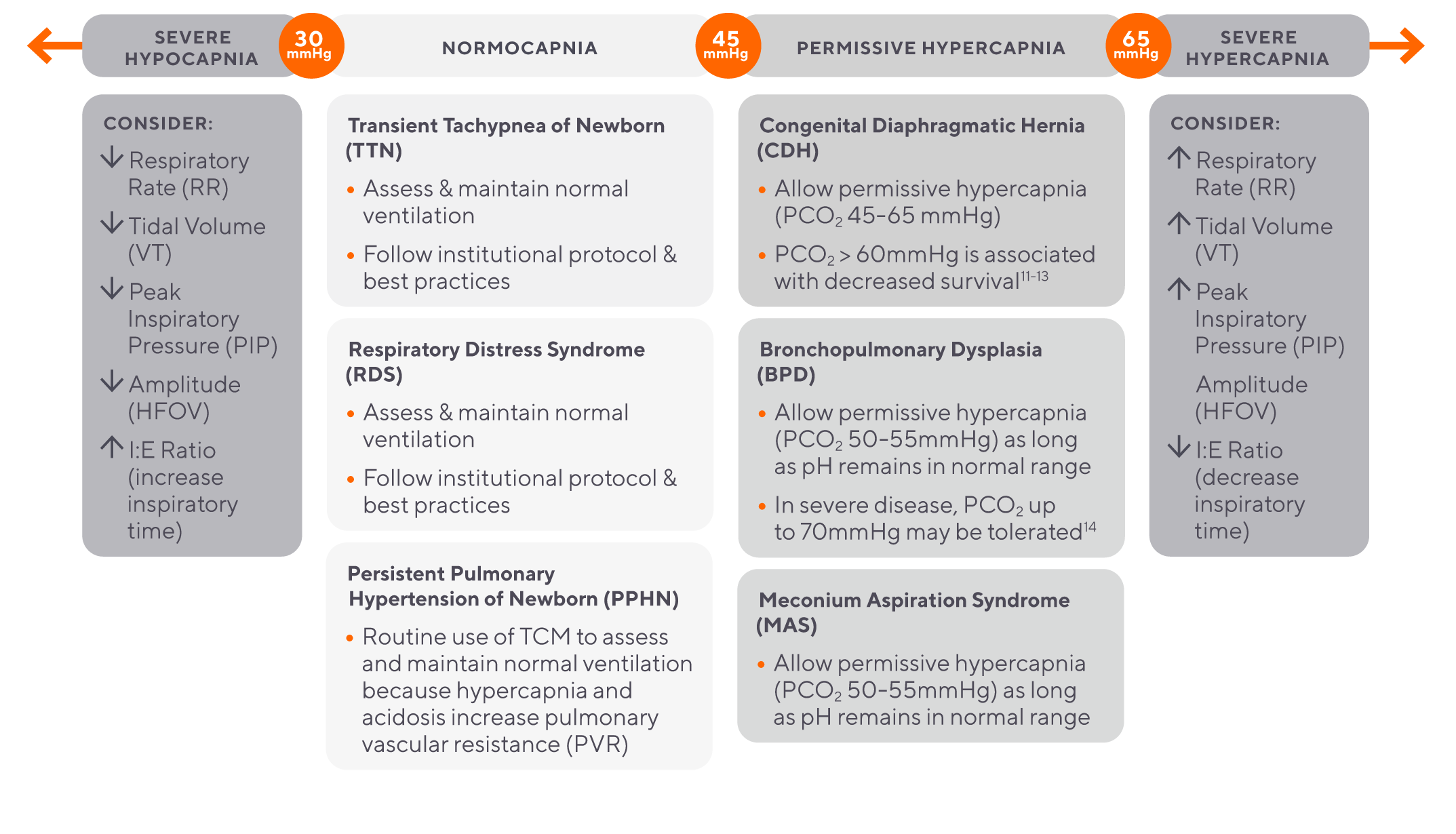
Table 1 outlines recommended CO2 targets for neonates based on their specific disease process, as well as recommended interventions for neonates experiencing severe hypocapnia or severe hypercapnia. The use of transcutaneous CO2 monitoring is valuable as we address the unique needs of each patient, providing enhanced titration support to maintain CO2 levels within the targeted range.
When effectively managing CO2, observing a normalization in CO2 levels following adjustments to ventilator settings is important. Transcutaneous monitoring provides instant visualizations of the impact of our titrations. We can see the changes happening, and that can help guide effective titrations and drive care.
Table 1. Recommended CO2 targets for neonates based on disease process and recommended titrations of ventilatory settings for severe hypocapnic and severe hypercapnic infants
Special Considerations
Edema
Edema can lead to altered capillary hemodynamics and cause an increase in the blood-skin barrier due to excess fluid. As a result, transcutaneous readings can be inaccurate, making it important to avoid edematous areas when monitoring. Avoiding areas of edema can be challenging, particularly for infants who are fluid-overloaded. In these cases, however, we can still leverage transcutaneous monitoring to track the trend of CO2 over time rather than using it for precise values.
Premature Skin
For neonates, especially in 22- and 23-weekers, the skin is thin and fragile, something that we want to make sure we consider when using our transcutaneous monitor. To prioritize skin integrity, we should ensure the sensor is at the appropriate temperature (41°C) and that we’re not leaving it on for too long (no more than 8 hours at a time). While the transcutaneous monitor will automatically apply appropriate settings, it is crucial to be aware of this consideration, so you can promptly identify deviations and take action if needed.
Note: It is recommended that the site time be evaluated and adjusted more frequently on premature skin to reduce the risk of skin injury.
Shunting and Low Perfusion
Correct sensor placement is crucial for patients with a shunt. As per AARC Clinical Practice Guidelines, it is recommended to place the transcutaneous sensor on the same side as a shunt.7
Low perfusion may cause transcutaneous CO2 values to be falsely high. In this situation, similar to the case of edema, it may be more helpful to utilize the monitor to trend CO2 to observe patterns and track progress during care.
Hypothermia
Hypothermia is an intervention we see often in NICUs, especially with hypoxic-ischemic encephalopathy (HIE) or post-cardiac arrest patients undergoing cooling therapy. Hypovolemia, reduced myocardial contractility, bradycardia, and the cardiovascular dysfunction associated with HIE can all lead to decreased cardiac output. Consequently, if the region experiences hypoperfusion, it’s important to note that the correlation between the transcutaneous and arterial CO2 may be poor. In this situation, establishing a correlation between the two values, rather than focusing on the exact values, becomes more clinically valuable. Again, this can be used for tracking the trend in CO2 throughout care.
AARC Clinical Practice Guidelines
The AARC Clinical Practice Guidelines provide recommendations for the effective use of transcutaneous CO2 monitoring in clinical care.7 If you’re not fully utilizing your transcutaneous monitors, haven’t developed guidelines or implemented it into any protocols, or don’t have devices at all, the AARC Clinical Practice Guidelines can guide you. I encourage you to develop a process for your NICU. It can be difficult to get started, but aligning with the AARC guidelines is going to create a standard practice. By adopting this approach, we can foster growth within the team, encouraging increased utilization of the technology. We have a great opportunity especially as respiratory therapists, to help drive care in an efficient, noninvasive manner.
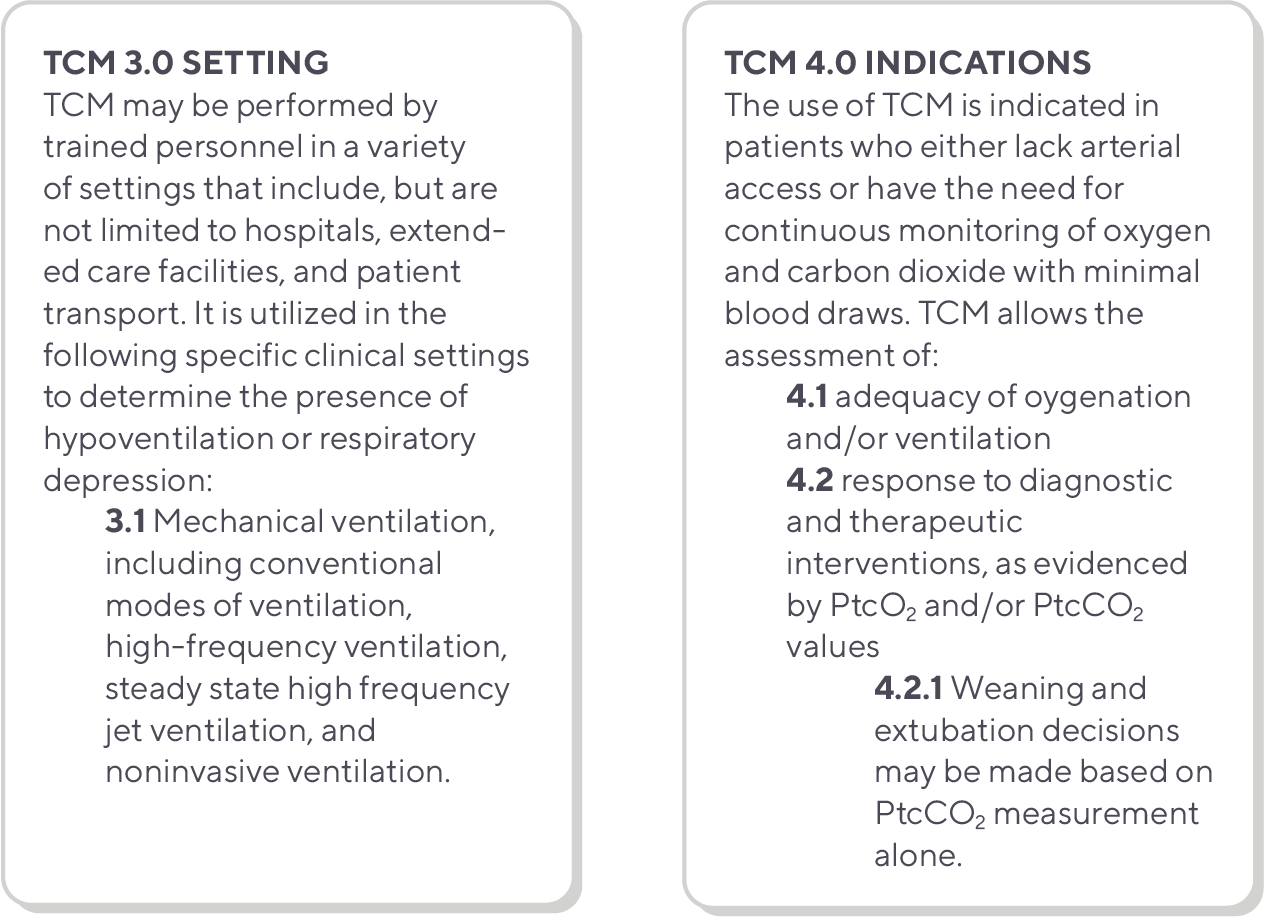
Figure 1. 2012 AARC Clinical Practice Guidelines for Transcutaneous Monitoring of Carbon Dioxide and Oxygen7
Benefits of Transcutaneous CO2 Monitoring in the NICU
Transcutaneous CO2 monitoring offers a noninvasive method to continuously analyze CO2 levels in all modes of ventilation. With continuous monitoring, we’re able to get real-time values for instant visualization of a patient’s response to care strategies. This newer technology preserves skin integrity for delicate patients and helps reduce the need for frequent blood draws.
Additional benefits of transcutaneous CO2 monitoring in the NICU:
- Provides accurate measurements
- Compatible with any ventilation strategy
- Supported by AARC guidelines
- Supports cost reductions
- Supports neuroprotective care
- Simplifies workflows
- Enables lung-protective ventilation strategies
Tips for Selecting a Monitoring Site
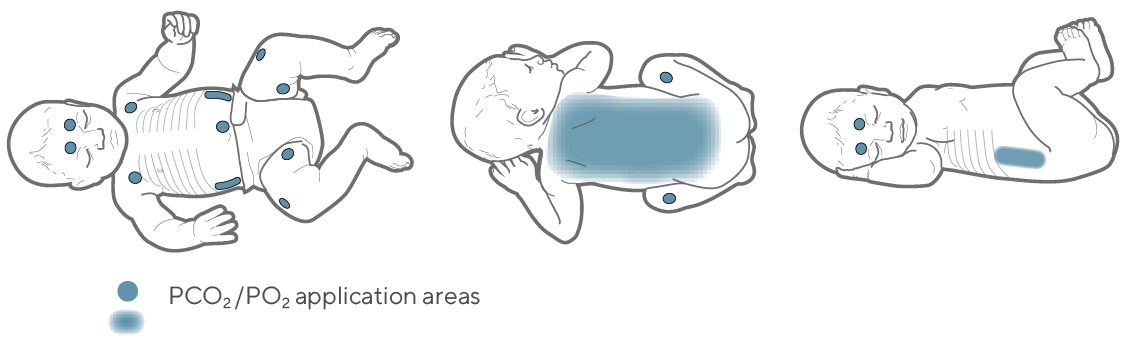
Choosing the ideal site for transcutaneous monitoring depends on your patient. The main determinant for location is perfusion, so the sensor is often placed on the thighs. However, in a 22-, 23-, 24-weeker, you might not have the real estate available in these areas, given the presence of a peripheral intravenous line (PIV) and/or other lines they may have.
In the past, we utilized the upper chest and thigh areas at our institution, but encountered challenges in achieving good correlation with these sites. In discussion with the manufacturer, we were advised to try the forehead. While some caregivers initially had concerns, once everyone embraced the idea, we saw remarkable improvements.
In most scenarios, the forehead is well-perfused, making it a great location for monitoring. For us, we keep our preemies midline for 72 hours, which also means there’s typically nothing obstructing this area. And when they are being repositioned, we don’t have to worry about the sensor as much, and whether there will be pressure when placed on it. It’s an easy-access area where we found much better correlation, and for my staff, it was less stressful to manage the sensor and troubleshoot appropriately. If you’re not using the forehead yet, I challenge you to try it.
Using Contact Gel: How Transcutaneous Monitoring Use Transformed at Rush
Our facility got by without using contact gel with our transcutaneous sensors for a long time. However, we were having correlation issues. We were experiencing frequent sensor errors and doing a lot of troubleshooting.
We learned from our clinical specialist that by using normal saline in place of contact gel, it meant that we were putting salt on an electrode — no wonder our membranes were struggling. When we replaced the saline with contact gel, we found our sensors were providing much better correlation. In addition, it was more cost-effective because our machines required less maintenance and troubleshooting, and we didn’t have to replace membranes as frequently.
Present day, our correlation has improved significantly, and I attribute that to using contact gel, as well as using the forehead as a monitoring site. Before, we owned 6 devices and had an average of about 3-4 in use. Now, while we still own 6, we are renting additional units because our usage has increased after gaining the trust of not only the RTs, but also complete medical teams.
The Five S’s: Troubleshooting Tips for Your Transcutaneous Monitoring System
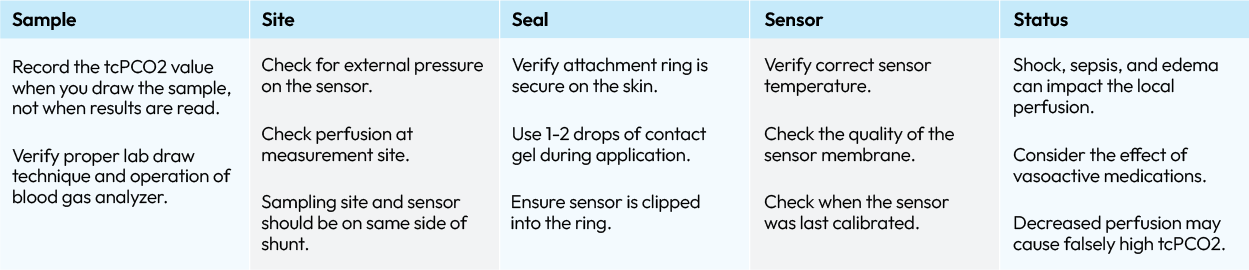
When it comes to troubleshooting your transcutaneous monitoring device, I like to refer to the Five S’s: sample, site, seal, sensor, and status. When you’re trying to figure out why your transcutaneous readings aren’t correlating as well as you’d like, figuring out which issue you’re dealing with can help you troubleshoot appropriately.
Integrating Transcutaneous Monitoring into NICU Protocols
At Rush, we implemented transcutaneous monitoring within our unit protocols, not only to increase the usage of the devices that we bought, but also to showcase its value and get everybody on the unit more comfortable with the technology.
NICU Conventional Ventilation Protocol
As part of our NICU conventional ventilation protocol, patients who are born at less than 35 weeks get a transcutaneous sensor placed on them for the first 72 hours of life, which allows us to start trending our gases with our tcPCO2. Because there is a high volume of gases and labs being drawn in the first 24 to 36 hours, we’re able to lay a good foundation for our correlation. This protocol also makes everybody more comfortable with transcutaneous monitoring in the NICU.
High-Frequency Jet Ventilator Protocol
As part of our care goals for our high-frequency jet ventilator protocol, any patient who goes on a jet ventilator must have a transcutaneous monitor.
Other Cases to Integrate Transcutaneous CO2 Monitoring
Other cases where we use transcutaneous monitoring are BPD and noninvasive ventilation (NIV). While we don’t necessarily have these protocolized yet, we still utilize transcutaneous monitoring to continuously monitor ventilation in these patients.
Bronchopulmonary Dysplasia (BPD)
Although gases are not frequently obtained from patients with BPD, their status can change quickly. These patients are often sweaty, which can make finding the proper transcutaneous sensor placement difficult. However, transcutaneous monitoring is a useful tool for this population, providing continuous CO2 visualization when gas sampling is infrequent.
Noninvasive Ventilation (NIV)
Patients on noninvasive mechanical ventilation are often teetering on the verge of needing an escalation of care, perhaps requiring intubation. Or, they may have just been extubated, and there is uncertainty about their ability to thrive. To be able to have constant CO2 monitoring in these cases is helpful in guiding our management strategies.
In Summary…
The more you use transcutaneous monitoring, the more comfortable you’re going to be and hopefully the better you’ll become at it. In the Rush University Children’s Hospital NICU, we already had active protocols, so we took the opportunity to integrate transcutaneous monitoring. This not only got our staff more comfortable using it, but also allowed our bedside caregivers to begin to trust the technology and rely on it during care.
As we continue utilizing transcutaneous CO2 monitoring, keeping up with current research remains valuable. However, actively engaging with other facilities, who are utilizing devices even more than we are, has also proven significant for our hospital. If you’re looking to embrace this technology, or increase its usage, consider reaching out to your colleagues at other hospitals to gain valuable insights on successful implementation. This has played a vital role in our adoption of transcutaneous monitoring in the NICU, and our progress towards utilizing its fullest potential for our patients.
References
- Fabres, J., et al. Both extremes of arterial carbon dioxide pressure and the magnitude of fluctuations in arterial carbon dioxide pressure are associated with severe intraventricular hemorrhage in preterm infants. Pediatrics. 2007.
- Ullman, A. J., et al. ‘True Blood’ The Critical Care Story: An audit of blood sampling practice across three adult, paediatric and neonatal intensive care settings. Aust Crit Care. 2016.
- Counsilman, C.E., et al. Iatrogenic blood loss in extreme preterm infants due to frequent laboratory tests and procedures. J Matern Fetal Neonatal Med. 2021.
- Widness, J.A. Pathophysiology of Anemia During the Neonatal Period, Including Anemia of Prematurity. Neoreviews. 2008.
- Grunau, R.E., et al. Neonatal pain, parenting stress and interaction, in relation to cognitive and motor development at 8 and 18 months in preterm infants. Pain.2009.
- Vinall, J., et al. Invasive procedures in preterm children: brain and cognitive development at school age. Pediatrics. 2014.
- Restrepo, R.D., et al. AARC clinical practice guideline: Transcutaneous monitoring of Carbon Dioxide and oxygen: 2012. J Respiratory Care. 2012.