How can transcutaneous CO2 monitoring support your sleep lab?

Sentec transcutaneous technology overcomes limits of pulse oximetry, arterial blood draws and capnography with continuous CO2 monitoring that combines ease of use and patient comfort, with accurate values regardless of ventilation method or ventilation/perfusion (V/Q) mismatch, and product features designed for sleep care settings.

This paper explores the clinical utility of transcutaneous monitoring in the sleep lab as highlighted in the literature, covering: 

  • The presence of hypercapnia in pediatric and adult patients frequently seen in the sleep lab, which may not be detected if measuring oxygenation alone
  • How nighttime arterial blood gases are undesirable in the sleep lab due to pain and sleep interruption, while daytime ABGs do not reflect nighttime hypercapnia
  • How end-tidal CO2 is ill-suited for use in the sleep lab, as it relies on the condition of airway and mask compliance, underestimates PaCO2 in patients with V/Q mismatch (like COPD patients), and underrepresents PaCO2 in both pediatric and adult sleep lab patients
  • The demonstrated safety of Sentec’s digital transcutaneous monitoring for patients in the sleep lab
  • The indication of transcutaneous monitoring in the AAST, AASM, and AARC Clinical Practice Guidelines
transcutaneous monitoring in the sleep lab: clinical utility and impact

How can transcutaneous CO2 monitoring support your sleep lab?

Sentec transcutaneous technology overcomes many of the current limitations and challenges associated with CO2 measurement in the NICU by providing accurate, continuous, noninvasive CO2 values regardless of ventilation method or V/Q mismatch. Sentec transcutaneous monitoring provides consistent, independent CO2 measurement all while promoting neuroprotective efforts to deliver clustered care, protect skin integrity, and reduce the frequency of blood draws.

This paper explores the clinical utility of transcutaneous monitoring in the sleep lab as highlighted in the literature, covering:

  • The presence of hypercapnia in pediatric and adult patients frequently seen in the sleep lab, which may not be detected if measuring oxygenation alone
  • How nighttime arterial blood gases are undesirable in the sleep lab due to pain and sleep interruption, while daytime ABGs do not reflect nighttime hypercapnia
  • How end-tidal CO2 is ill-suited for use in the sleep lab, as it relies on the condition of airway and mask compliance, underestimates PaCO2 in patients with V/Q mismatch (like COPD patients), and underrepresents PaCO2 in both pediatric and adult sleep lab patients
  • The demonstrated safety of Sentec’s digital transcutaneous monitoring for patients in the sleep lab
  • The indication of transcutaneous monitoring in the AAST, AASM, and AARC Clinical Practice Guidelines

Meet the tCOM+

Developed with care, designed for confidence.

The tCOM+ offers continuous monitoring of tcPCO2, SpO2, and PR with a sleek new look and feel. This latest model includes significant software advances that improve workflow for providers, while continuing to support reduced blood draws and proactive ventilator management across care areas.
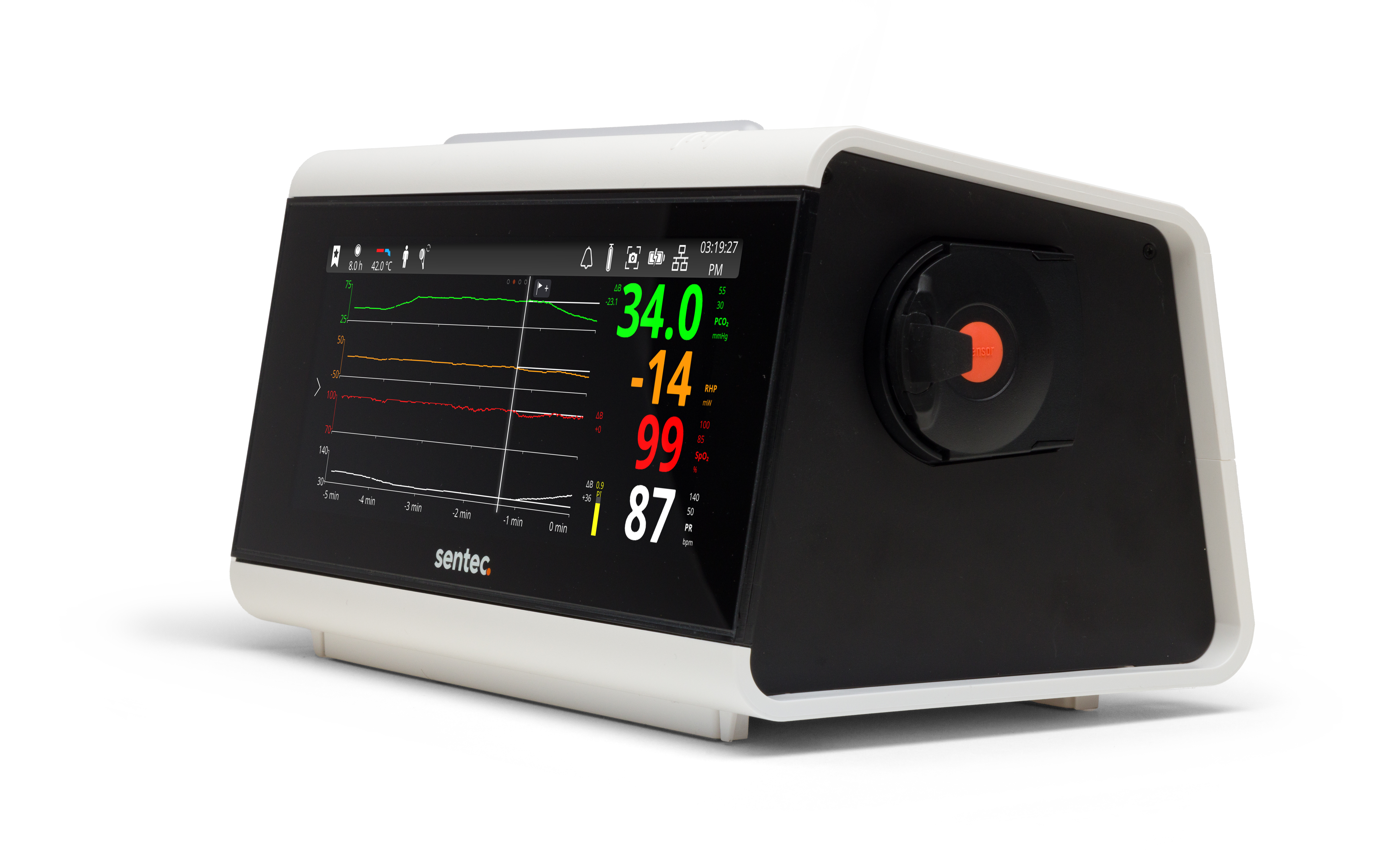
tCOM-device-angled

Stay up-to-date with Sentec


Related Posts

  • Sentec Article

    Methods of Monitoring Carbon Dioxide (CO2) in the NICU

    Learn how CO2 is monitored in the NICU. Compare arterial blood gas, end-tidal CO2, and transcutaneous monitoring to support precise neonatal ventilation management.

  • Sentec Article

    Carbon Dioxide (CO2) Monitoring in the Sleep Lab

    Explore the importance of CO₂ monitoring in the sleep lab, including methods like transcutaneous and end-tidal monitoring, to better detect ventilation issues and improve outcomes in patients with sleep-disordered breathing.

  • Sentec Article

    CO2 Levels in Neonates

    Learn why CO₂ levels matter in neonates, the risks of hypo- and hypercapnia, and how CO₂ monitoring guides safe, effective respiratory support in the NICU.