
Effective use of transcutaneous CO2 (tcPCO2) monitoring depends on confidence in its readings. When care teams trust the data, they can rely on it to make informed care decisions for their patients.
Clinical teams can support strong correlation between tcPCO2 measurements and arterial blood gases by following simple best practices and knowing how to troubleshoot effectively. This guide outlines how to optimize accuracy when monitoring, and highlights a feature of the Sentec system, relative heating power (RHP), that can aid in troubleshooting.

Best Practices to Support Strong Correlation
To make sure transcutaneous CO2 monitors are performing at their best and deliver optimal accuracy, clinical teams should follow these core practices:
-
- Calibrate the sensor with every site change.
- Always keep the monitor turned on and connected to power.
- Keep the sensor in the Docking Station between monitoring sessions.
- Focus on good sensor placement and measurement site perfusion. (More on choosing the right sensor placement below!)
CHAPTERS
The 5 S’s of tcPCO2 Monitoring
While Sentec transcutaneous CO2 monitoring readings are generally very accurate, there are some situations where correlation is challenging or where the readings don’t seem to reflect patient condition.
If a transcutaneous reading is questionable, a clinician can do a quick quality-assurance test by following the 5 S’s:
Sensor
Your sensor is the foundation for achieving accurate measurements. To check that your sensor is in good working condition, you can follow these steps:
✓ Check that the sensor temperature is appropriate for the patient and measurement parameters.
- A heated sensor helps to increase and stabilize the local blood flow.
- For tcPCO2 monitoring, Sentec recommends monitoring at 41°C for neonatal patients and 42°C for adults.
✓ Check the sensor membrane to see if it is intact and in good condition.
- If needed, change the sensor membrane and allow the sensor to stabilize in the Docking Station before placing on the patient.
✓ Check when the sensor was last calibrated.
- The sensor may become more unstable closer to the end of the measurement interval.
Site
Sensor accuracy depends on good local perfusion, which can be impacted depending on the measurement location. When values are not correlating as expected, consider the following factors:
✓ Check for external pressure on the sensor , which may cause reduced blood flow at the measurement site and falsely high tcPCO2 values.
- Ensure there is no pressure on the sensor from the patient’s position, dressings, medical devices, clothing, or diapers.
✓ Check the measurement site.
- Ensure that the selected measurement site has adequate perfusion and if necessary, move the sensor to a more central location.
✓ Check the perfusion in patients with shunts.
- The blood gas sampling site and measurement site should be on the same anatomical side of the shunt.
Seal
An air-tight seal between the sensor and skin is critical for accuracy. To ensure a proper seal, check for the following:
✓ Check that the attachment ring is securely adhered to the skin.
- During sensor application, run your finger around the perimeter of the ring to ensure full adhesion.
✓ Check the position of the sensor in the attachment ring or strain on the sensor cable.
- When the sensor is exposed to ambient air, the CO2 level will decrease.
✓ Check that there is sufficient Contact Gel between the sensor and skin.
- Use 1-2 drops of Contact Gel with every sensor application.
Status
A patient’s status must also be considered when evaluating the correlation of your tcPCO2 readings, as it could be impacting perfusion. Consider the following:
✓ First, check the patient.
- If tcPCO2 values are high and the patient’s status has changed, they may require further assessment.
✓ Check for patient conditions that may affect perfusion.
- Shock, sepsis, and edema can all affect local skin perfusion.
- Patients on a cooling protocol may have decreased local perfusion.
✓ Consider the effect of vasoactive drugs on local perfusion.
- E.g., epinephrine, norepinephrine, phenylephrine, especially when administered continuously using syringe or infusion pumps.
✓ Keep in mind that decreased perfusion to the skin can result in tcPCO2 readings that are higher than blood gas values.
Sample
Finally, it’s important to consider how technique variability can impact transcutaneous CO2 readings and to consider the following while troubleshooting:
✓ In patients with shunts, ensure that the sensor and the sampling site are both pre- OR post-ductal.
✓ Pay attention to the blood gas procedure.
- If doing a capillary sample, take the time to warm the heel, allow the blood to flow naturally, and try not to squeeze the heel.
- For arterial samples, follow protocols to draw waste before drawing the sample.
✓ Record the tcPCO2 value when the blood is drawn – not when the result is read.
- The tcPCO2 value might change shortly after the blood draw.
Choosing a Good Sensor Location
As mentioned above, adequate local perfusion is essential for accurate transcutaneous CO2 measurements. Selecting a site with good perfusion can help optimize accuracy and support correlation with blood gas values.
Recommended Monitoring Sites for Neonates
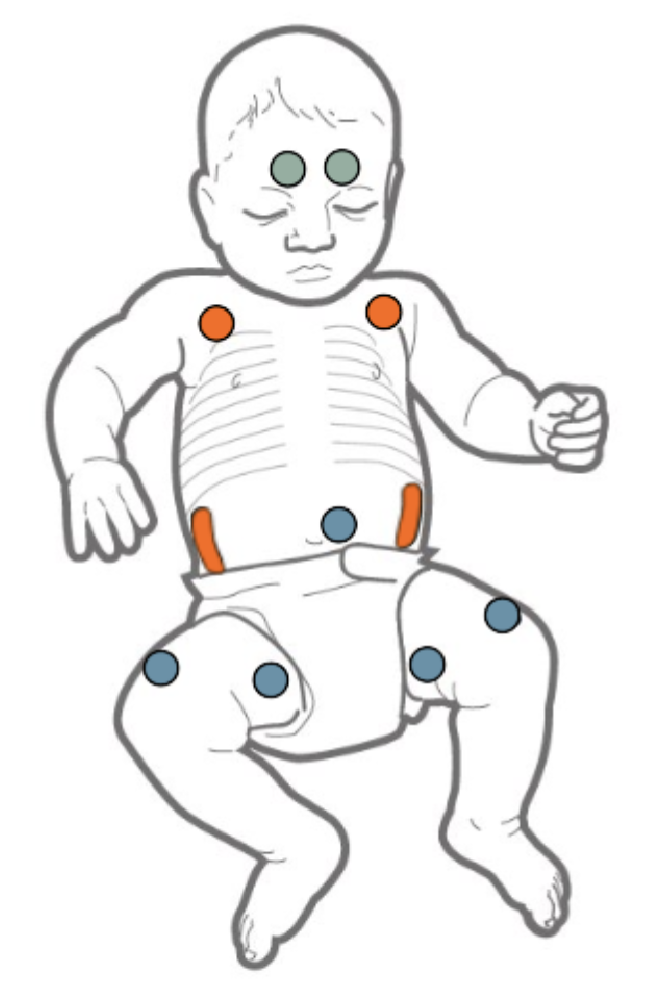
Although correlation should be expected with any recommended site, our internal data indicates that certain sites exhibit stronger correlation:
Good: Thigh, Abdomen
Better: Forehead
Best: Chest, Lateral/Flank, Back
Note: These recommendations may not be the same for every patient – consider the 5 S’s to choose the best site.
Recommended Monitoring Sites for Adults
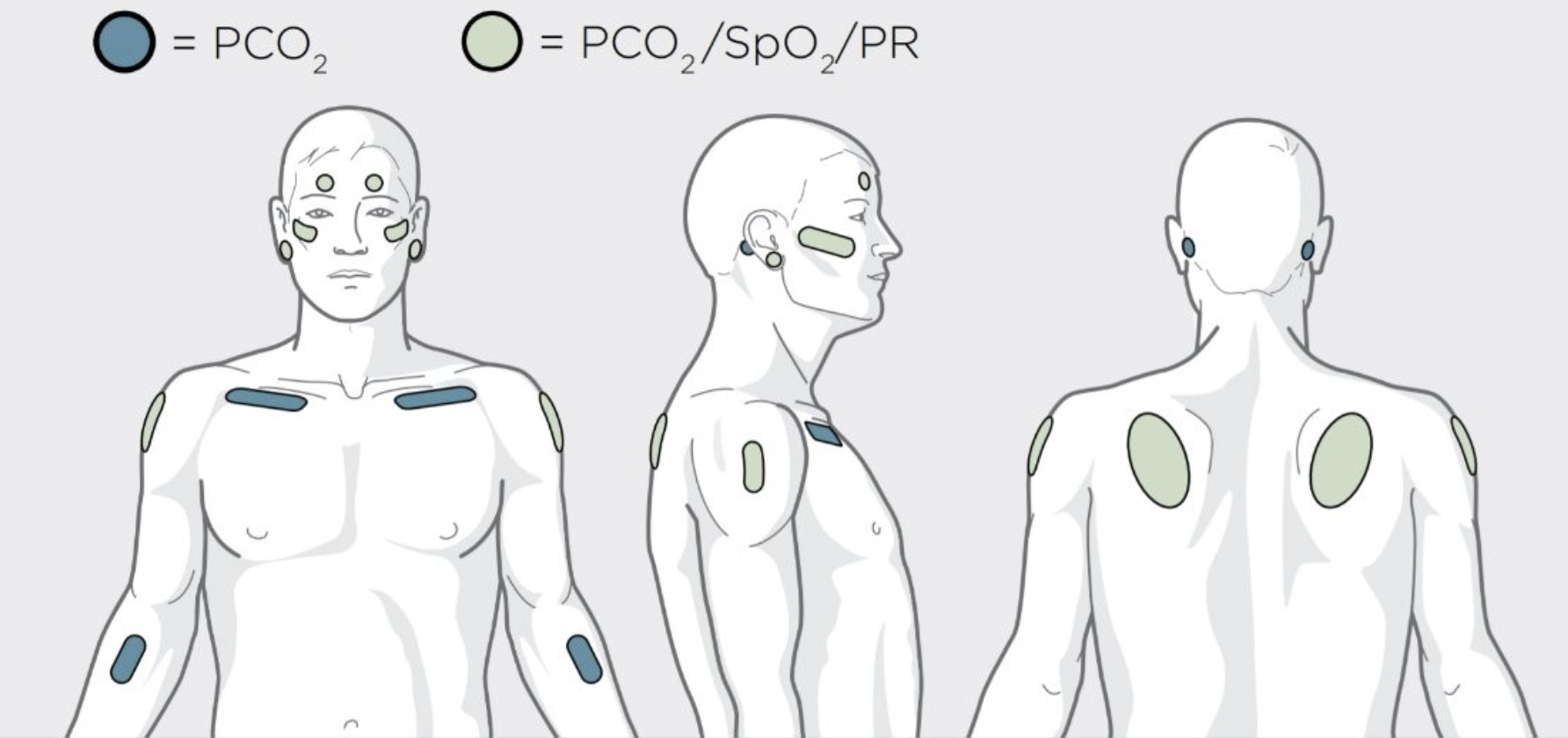
Utilizing Relative Heating Power
Relative heating power (RHP) is a feature of the Sentec system that can provide insight into local perfusion and help clinicians better interpret changes in transcutaneous CO2 measurements.
RHP reflects the difference between the sensor’s current heating power – meaning the amount of energy required to maintain the target monitoring temperature – and a stored reference value. Because the sensor’s heating demand is influenced by local blood flow, RHP can serve as a real-time indicator of perfusion changes at the monitoring site.
- When perfusion increases, greater blood flow will have an increased cooling effect on the sensor. As a result, more energy is needed to maintain the desired temperature, and RHP will rise.
- When perfusion decreases, there will be a decreased cooling effect on the sensor. In this case, less energy is needed to maintain sensor temperature, and RHP will fall.
- When local blood flow remains stable, RHP will remain stable.
RHP can help differentiate whether changes in tcPCO2 are driven by a shift in respiratory status or a change in local perfusion:
- If tcPCO2 changes while RHP remains stable,the cause is likely a change in the patient’s respiratory status.
- If both tcPCO2 and RHP change together,the shift is more likely due to altered local blood flow at the sensor site.
Ultimately, RHP adds valuable context to tcPCO2 trends, helping teams distinguish true physiological changes from measurement-related factors, such as sensor positioning or pressure at the monitoring site. With this, they can act confidently, whether addressing clinical needs or appropriately troubleshooting to achieve stronger correlation.
Resource for Your Team: Correlation Tracker
Our correlation tracker simplifies the process of comparing transcutaneous readings with blood gas values.