
In the intensive care unit (ICU), secretions are often seen as an unavoidable byproduct — simply par for the course for critically ill patients. However, evidence suggests they may play a more consequential role, warranting greater attention in acute care.
Rather than being a passive consequence of illness or mechanical ventilation, mucus buildup can fuel a self-reinforcing cycle in which infection, impaired lung function, and continued secretion accumulation feed into one another. If not addressed, this cycle may be trapping patients in ongoing respiratory compromise and complicating the path to extubation and recovery.
This cycle raises an important question: have secretions become so expected, so routine, that their clinical significance is being overlooked? And if so, should ICU strategies place greater emphasis on proactively disrupting this cycle?
What Does the Vicious Cycle of Secretions Look Like in the ICU?
This self-perpetuating cycle of respiratory compromise, sometimes called the “vortex,” was first described by P.J. Cole in the context of bronchiectasis1 and is well-recognized in both bronchiectasis and cystic fibrosis. Yet the same principles can apply broadly across many respiratory conditions.

In the ICU, the cycle can look like this:
Secretions accumulate
Mucociliary clearance and cough, the body’s natural defenses for removing mucus and pathogens, are often impaired in intensive care unit (ICU) patients. This can be driven by underlying disease and infection, as well as intubation-related factors such as endotracheal tube placement, sedation, and inadequate airway humidification.2 When these primary clearance mechanisms are compromised, mucus readily accumulates in the airways.
↓
Infection occurs
Accumulated mucus creates an ideal environment for microbial growth,3 which can lead to ventilator-associated pneumonia (VAP) and other respiratory infections. In response to infection, the body’s immune system can trigger even more mucus production, further fueling the cycle.
↓
Inflammation increases
In addition to driving excess mucus production, infection also initiates another immune response: inflammation. This inflammation can directly damage lung tissue,4 including the epithelial barrier5 (the lungs’ first line of defense against pathogens), and may contribute to acute lung injury.6 As a result, lung function becomes increasingly compromised, leaving the patient more vulnerable to further secretion retention and infection as the cycle continues.
↓
Cough strength weakens
Inflammation and the resulting lung damage can further weaken cough, which is often already impaired by intubation, immobility, medications (sedatives and analgesics), and muscle fatigue during mechanical ventilation. This reduced cough efficiency reduces the airways’ ability to clear mucus.
↓
Secretions continue to accumulate, reinforcing the cycle
Diminished cough strength allows secretions to accumulate and to continue fueling the cycle of infection, inflammation, and lung compromise.
The cycle of secretions is not linear, with each component amplifying the others and none acting in isolation. However, secretions frequently function as a central driver, linked to multiple processes: they can trigger intubation while also resulting from it and emerge from infection while simultaneously promoting it. This complex, secretion-fueled cycle underlies the progressive lung compromise often observed in ICU patients.
The Impact on Patient Outcomes
Evidence shows that retained secretions, along with their impact on gas exchange, can negatively influence a patient’s trajectory and are tied to critical ICU outcomes such as extubation success – a top priority in the ICU, as reintubation and ventilator days are is linked to longer hospital stays, higher costs, and increased mortality.7,8
Research has shown that one of the strongest and most consistent predictors of extubation failure is the presence of secretions combined with an impaired ability to clear them due to weak cough. Effectively managing secretions can therefore be crucial for supporting successful extubation.
For example, one study found that among patients reintubated within 24 hours of extubation, the most common cause, cited in 66% of cases, was an inability to clear secretions. Frequent suctioning (more than once every two hours before extubation) was also identified as an independent predictor of failure.9
Another study showed that patients with low peak expiratory flow, a marker of weak cough, had nearly a 25% risk of reintubation.10
Shifting From Reactive to Proactive Strategies
Although secretions have been shown to complicate a patient’s clinical course, ICU practices often fall short in addressing them effectively or proactively. Secretion clearance is frequently treated as a routine part of daily care — necessary, of course, but competing with other urgent tasks, especially amid widespread staffing shortages. It’s easy to view secretions as inevitable in intubated patients, secondary to infection, or something that will resolve on its own with time or antibiotics.
When ICU practices do address secretions, the typical workflow tends to be reactive. Suctioning and ventilator checks dominate daily responsibilities, and stable ventilator readings are often interpreted as a sign that no intervention is needed. More intensive interventions usually occur only when clear changes arise, for example, altered vital signs or radiographic evidence of atelectasis. While the current approach addresses immediate concerns, it can miss opportunities for early intervention.
Respiratory therapists are uniquely positioned to reshape how secretion management is approached in the ICU, and empowering them with the autonomy to lead this change can shift care from routine care to proactive strategy.
One way ICU teams can drive this shift is through RT-driven protocols. These evidence-based, structured procedures allow RTs to initiate, adjust, and guide treatment within the framework of a physician’s standing orders. Research shows that such protocols can improve outcomes. For example, one unit’s RT-driven weaning protocol led to higher extubation success and shorter ICU stays.11 By authorizing RTs to act independently and at the top of their scope, these protocols streamline workflow, minimize delays in care, and help drive measurable improvements in patient outcomes.
In practice, RT-led secretion management may be incorporated into existing weaning or ventilation protocols, or established as a standalone airway clearance protocol. By defining assessment schedules, therapy strategies, goals, and escalation criteria, RT-driven protocols can help ICUs ingrain a more proactive approach to secretions into daily practice.
Intrapulmonary Percussive Ventilation (IPV) Therapy in Acute Care
For airway clearance protocols to be effective, RTs need to be equipped with the right tools. Routine suctioning and subglottic drainage remain cornerstone practices, yet these techniques may not be sufficient to fully address secretion burden, particularly in the smaller airways, where mucus can persist, continue to promote infection, and obstruct ventilation.
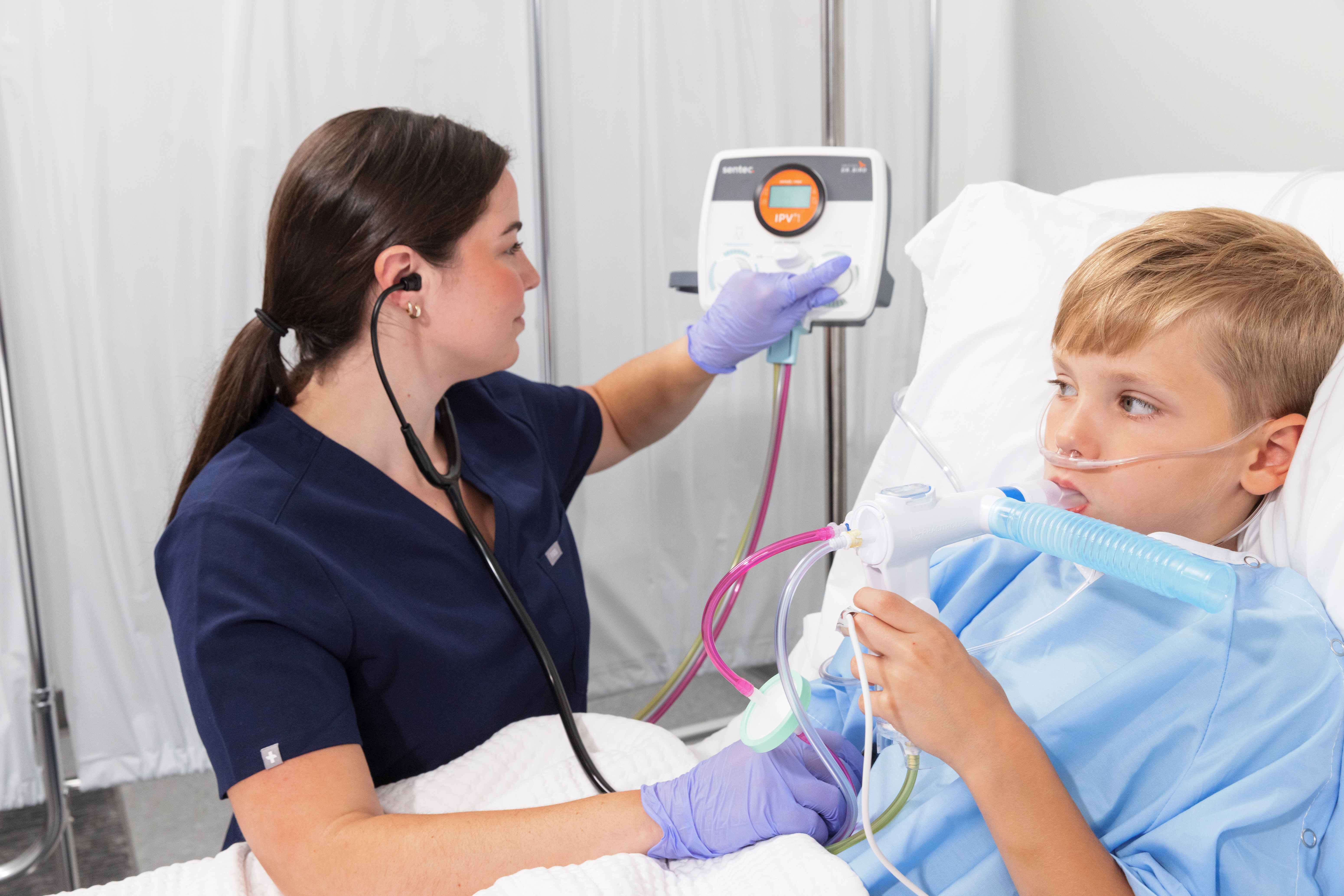
Used by respiratory teams in PICUs, chronic home care, and increasingly in adult ICUs, IPV delivers high-velocity, high-frequency, sub-tidal volume pulses that break up secretions deep in the lungs and mobilize them proximally. By reaching beyond obstructed areas, it can help relieve air trapping and support recruitment of collapsed lung regions, and by supporting secretion clearance, it can help disrupt the vicious cycle that is so often seen in acutely ill patients.
Intrapulmonary Percussive Ventilation (IPV) Therapy in Acute Care
For airway clearance protocols to be effective, RTs need to be equipped with the right tools. Routine suctioning and subglottic drainage remain cornerstone practices, yet these techniques may not be sufficient to fully address secretion burden, particularly in the smaller airways, where mucus can persist, continue to promote infection, and obstruct ventilation.
Used by respiratory teams in PICUs, chronic home care, and increasingly in adult ICUs, IPV delivers high-velocity, high-frequency, sub-tidal volume pulses that break up secretions deep in the lungs and mobilize them proximally. By reaching beyond obstructed areas, it can help relieve air trapping and support recruitment of collapsed lung regions, and by supporting secretion clearance, it can help disrupt the vicious cycle that is so often seen in acutely ill patients.
References:
- Cole, P.J. Inflammation: a two-edged sword—the model of bronchiectasis. Eur J Respir Dis Suppl. 1986.
- Goetz, R.L., et al. Mucus Clearance Strategies in Mechanically Ventilated Patients. Front Physiol. 2022.
- Fahy, J.V., et al. Airway mucus function and dysfunction. N Engl J Med. 2010.
- van der Lee, L., et al. Efficacy of Respiratory Physiotherapy Interventions for Intubated and Mechanically Ventilated Adults with Pneumonia: A Systematic Review and Meta-Analysis. Physiother Can. 2021.
- Swenson, K.E., et al. Pathophysiology of Acute Respiratory Distress Syndrome and COVID-19 Lung Injury. Crit Care Clin. 2021.
- Liu, H., et al. Acute lung injury: pathogenesis and treatment. J Transl Med. 2025.
- Epstein, S.K., et al. Independent effects of etiology of failure and time to reintubation on outcome for patients failing extubation. Am J Respir Crit Care Med. 1998.
- Gowardman, J.R., et al. The effect of extubation failure on outcome in a multidisciplinary Australian intensive care unit. Crit Care Resusc. 2006.
- Haruna, J., et al. Frequent tracheal suctioning is associated with extubation failure in patients with successful spontaneous breathing trial: a single-center retrospective cohort study. JA Clin Rep. 2022.
- Thille, A.W., et al. Risk factors for and prediction by caregivers of extubation failure in ICU patients: a prospective study. Crit Care Med. 2015.
- Kirakli, C., et al. Effectiveness and safety of a protocolized mechanical ventilation and weaning strategy of COPD patients by respiratory therapists. J Thorac Dis. 2014.
- Kushwaha, N., et al. Bronchial Hygiene In Critical Care: Enhancing Pulmonary Function In Mechanically Ventilated Patients. Eur J Mol Clin Med. 2025.
- Strickland, S.L., et al. AARC clinical practice guideline: effectiveness of nonpharmacologic airway clearance therapies in hospitalized patients. Respir Care. 2013.